

The rise of smart terrariums
I remember when keeping a bearded dragon meant hovering over analog thermometers and manually toggling heat lamps every few hours. It was tedious and prone to error. We're finally moving toward automated tanks that handle the heavy lifting. This isn't just for tech enthusiasts; it's about keeping the environment stable enough that the dragon actually thrives rather than just surviving.
The shift is driven by two key factors: increasingly sophisticated sensors and the falling cost of microcontrollers. Sensors can now accurately measure temperature, humidity, UVB exposure, and even detect subtle changes in a dragon’s behavior. Microcontrollers, like the ESP32, can process this data and automatically adjust equipment to maintain ideal settings. What used to require constant human intervention can now be handled intelligently by a machine.
Early adopters experimented with DIY solutions using Arduino and Raspberry Pi, but 2026 sees commercially available, integrated systems becoming more common. These systems promise to reduce the workload for owners, minimize the risk of human error, and ultimately, improve the health and longevity of bearded dragons. It’s a transition that’s making advanced reptile keeping accessible to a wider audience.
I believe this technology is a game changer. While a dedicated owner can provide excellent care through manual methods, a smart terrarium offers a level of consistency and precision that’s difficult to achieve otherwise. It's a proactive approach to care, aiming to prevent problems before they even arise, rather than simply reacting to them.
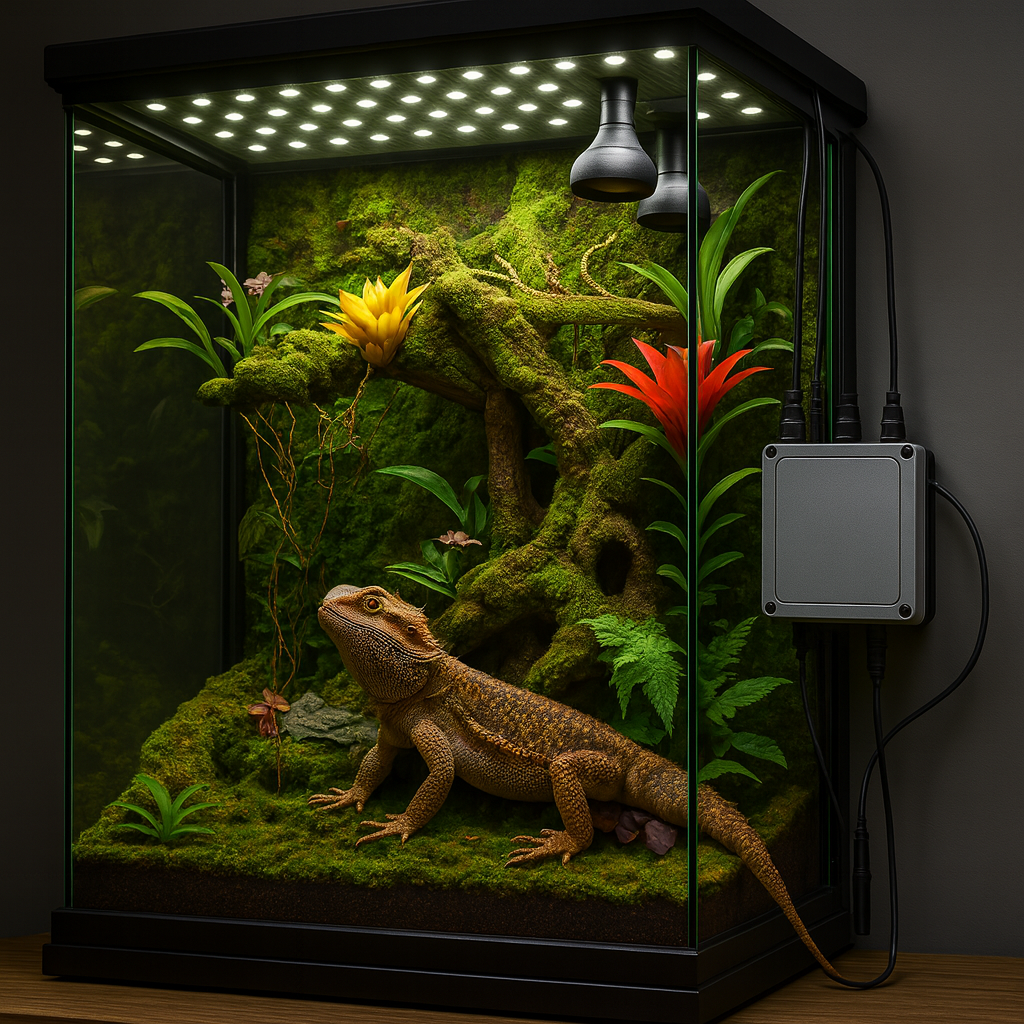
Automating the environment
Maintaining the correct environmental conditions is paramount to a bearded dragon’s health. They require a specific temperature gradient, with a basking spot around 100-110°F and a cool side around 75-80°F. Humidity levels should be kept relatively low, typically between 30-40%, and proper UVB/UVA exposure is essential for vitamin D3 synthesis and calcium absorption. Automating these factors is where smart terrariums truly shine.
Smart thermostats, like the Zoo Med ReptiTemp Digital Thermostat with remote monitoring capabilities, are the foundation of temperature control. These devices connect to heating elements and automatically adjust power output to maintain the desired temperature. Automated misting systems, such as those offered by Little Monster Sales, can maintain appropriate humidity levels without over-saturating the enclosure. These systems often incorporate humidity sensors and timers.
Perhaps the most significant advancement is in dynamic UVB lighting. Traditional UVB bulbs degrade over time, reducing their output. Some newer systems, like the ArcadiaPro T5 UVB kits paired with smart controllers, can monitor UVB levels and automatically adjust the lamp’s output or even signal when a bulb needs replacing. This ensures your dragon is consistently receiving the necessary UVB radiation.
However, automation isn’t foolproof. Fail-safes are absolutely critical. A good system should include backup heating elements, alarms that alert you to temperature or humidity fluctuations, and the ability to manually override automated settings. If a sensor malfunctions, you need to know immediately and have a plan to ensure your dragon’s safety. I recommend regularly testing all safety features.
Consider a system that logs environmental data. Knowing the temperature and humidity trends within the terrarium can help you identify potential issues before they escalate. Some systems even offer predictive maintenance alerts, notifying you when components are likely to fail.
- Basking spots need to stay between 100-110°F, while the cool side sits at 75-80°F.
- Keep humidity low, ideally 30-40%, to avoid respiratory issues.
- UVB/UVA: Essential for vitamin D3 synthesis
Health monitoring with AI
AI and machine learning are beginning to play a role in monitoring a bearded dragon’s health, although the technology is still in its early stages. The goal isn't to replace veterinary care, but to provide early detection of potential problems, allowing for more timely intervention. Most current systems focus on non-invasive methods, analyzing readily available data.
One promising approach involves analyzing behavioral patterns through camera footage. AI algorithms can track activity levels, basking duration, appetite, and even subtle changes in posture. A sudden decrease in activity or a refusal to bask could indicate illness. Companies like DragonEye are developing systems that use computer vision to monitor these behaviors.
AI can also detect changes in appearance. Algorithms can analyze images to assess skin color, scale condition, and the presence of any visible abnormalities. A loss of color or the appearance of lesions could be early signs of a health issue. This is a developing field, and accuracy varies.
Perhaps surprisingly, some researchers are exploring the use of image recognition to analyze fecal matter. By analyzing the color, consistency, and presence of undigested food, AI can potentially identify digestive problems or parasitic infections. This is still largely experimental, and requires clear, well-lit images.
Don't expect these sensors to replace a vet. An algorithm might spot a change in movement, but it won't know if that's a respiratory infection or just a lazy afternoon. I'm skeptical about the current accuracy of 'wellness scores,' but the data is at least a starting point for a professional diagnosis.
Currently, the data collected is often presented as a 'wellness score,' giving owners a general indication of their dragon's health. However, interpreting these scores requires caution. A low score doesn't necessarily mean your dragon is seriously ill, but it warrants closer observation and possibly a vet visit.
Privacy is also a consideration. Systems that record video footage or collect behavioral data raise concerns about data security and potential misuse. Choose systems from reputable companies with clear privacy policies.
Smart Feeding Systems & Diet Tracking
Automated feeding systems can dispense appropriate amounts of food at scheduled times, ensuring your dragon receives a consistent and balanced diet. These systems can handle both live insects and pre-made diets. Some systems, like the Fluker’s Automated Feeder, are designed specifically for insects, while others can accommodate a wider range of food types.
AI can be used to track a dragon’s dietary intake and identify potential nutritional deficiencies. By monitoring the types and quantities of food consumed, the system can generate reports on nutrient intake. This information can be used to adjust the diet and ensure the dragon is receiving all the necessary vitamins and minerals.
Variety is crucial in a bearded dragon’s diet. They require a mix of insects, vegetables, and fruits. Smart systems can help owners maintain a balanced feeding schedule by reminding them to offer different food items on different days. Some systems can even suggest appropriate food combinations based on the dragon’s age and health status.
Integrating feeding systems with health monitoring can provide valuable insights. For example, a decrease in appetite could be an early sign of illness, while a sudden increase in appetite could indicate a growth spurt. By linking diet to activity levels and overall health, owners can gain a more comprehensive understanding of their dragon’s well-being.
Troubleshooting & System Integration
Even the most sophisticated smart terrarium systems can encounter problems. Sensor failures, software glitches, and network connectivity issues are all potential headaches. It’s important to be prepared to troubleshoot these issues and have a backup plan in place.
Common problems include temperature sensor inaccuracies, humidity sensor drift, and UVB sensor malfunctions. Regularly calibrating sensors and checking their readings against independent measurements can help identify and correct these issues. Software updates can often fix glitches and improve system performance.
Network connectivity is also essential for remote monitoring and control. Ensure your system is connected to a stable Wi-Fi network and that the signal strength is sufficient. If you experience connectivity problems, try restarting your router or moving the terrarium closer to the access point.
System compatibility is another important consideration. Can the smart terrarium system integrate with existing smart home platforms like Alexa or Google Home? This allows you to control the system using voice commands and automate tasks even further. Many systems now offer IFTTT (If This Then That) integration, allowing for custom automation rules.
Remote monitoring and control are particularly useful for owners who travel frequently. With a smartphone app, you can check the terrarium’s temperature, humidity, and UVB levels from anywhere in the world. You can also adjust settings remotely if necessary, giving you peace of mind while you’re away.
Automated Feeder Comparison for Bearded Dragons
| Feeder Type | Cost | Reliability | Ease of Cleaning | Insect Suitability |
|---|---|---|---|---|
| Hopper Feeders | Generally Lower | Moderate - Mechanical parts can fail | Moderate - Requires regular emptying and occasional disassembly | Best for larger insects like crickets and roaches |
| Portion Control Feeders | Moderate | Generally High - Digital timers are reliable | Better - Often have removable parts for easier cleaning | Good for a variety of insects, but size limitations exist |
| Live Insect Dispensers | Higher | Moderate - Relies on insect behavior and dispenser mechanism | More Difficult - Requires regular cleaning to prevent mold/bacteria | Best for smaller, actively moving insects like fruit flies (for juveniles) |
| Hopper Feeders | Lower Initial Investment | Susceptible to jamming | Can be challenging to disinfect thoroughly | Less suitable for delicate insects |
| Portion Control Feeders | More Consistent Feeding | Dependent on power source | Easier to maintain hygiene | May not accommodate very large prey items |
| Live Insect Dispensers | Promotes Natural Foraging | Insect escape possible | Requires frequent maintenance | Limited to insects that will actively move into the dispenser |
Qualitative comparison based on the article research brief. Confirm current product details in the official docs before making implementation choices.
What's next for reptile tech
The future of bearded dragon care is likely to be even more data-driven and automated. We can expect to see more sophisticated AI diagnostics, capable of detecting subtle signs of illness that are currently undetectable. Imagine a system that can analyze a dragon’s blood or urine remotely, providing a comprehensive health assessment.
Systems may also be able to automatically adjust environmental conditions based on a dragon’s individual needs. By learning a dragon’s preferences and physiological responses, the system can optimize temperature, humidity, and UVB exposure for maximum comfort and health.
Remote veterinary consultations facilitated by AI-powered health monitoring could become commonplace. A vet could remotely access data from the terrarium, review the dragon’s health history, and provide personalized recommendations. This could be particularly beneficial for owners who live in remote areas or have limited access to veterinary care.
While these advancements hold immense promise, it’s important to remain grounded. Technology is a tool, and it should be used to enhance, not replace, responsible pet ownership. The human element – careful observation, attentive care, and a genuine bond with your dragon – will always be the most important factor in ensuring a happy and healthy life.
What is your biggest concern when considering a smart terrarium system for your bearded dragon?
As smart tank automation and AI health monitoring tools become more accessible to reptile keepers, we want to hear from you. Whether you are already using connected devices in your enclosure or just starting to explore the options, your input helps our community understand what matters most. Vote below!

No comments yet. Be the first to share your thoughts!